Services · Agentic teams
A whole team, run by agents
A team of AI agents that runs a whole part of your business — under one human lead: you. Designed with you, built into your tools, run for you. The most common shape is a commercial team, and that’s the example on this page; the model fits wherever the recurring work lives.
Your week comes back
The recurring work — research, follow-ups, data upkeep, reporting — runs every morning before you’re at your desk. You read one short digest a day and make the calls only you can make.
A foundation for growth
Leads researched and pitched, customers kept warm, content shipped on schedule. The work that always slips when humans are busy stops slipping, because the team never has a busy week.
A team that compounds
Every correction you make is written into the team’s rules, so the standard rises month on month.
You stay in control
Nothing customer-facing sends without your approval, every action leaves a record you can check, and the whole team is built in your accounts — yours to read and change.
What an agentic team is
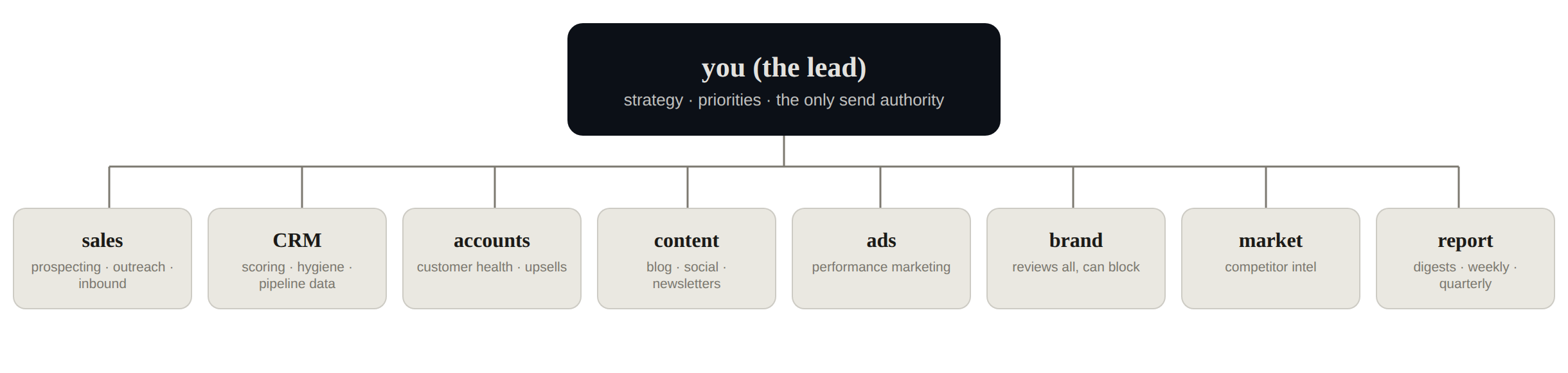
An agentic team is a set of AI workers with defined jobs that fit together, run by one human. Take the commercial example above: your sales motion is one loop — get leads, convert them, keep the customers, plan the next move — and the team staffs that loop with a sales agent, a CRM agent, a content agent, an accounts agent, a reporting agent, and specialists where the business needs them. Each agent is a written job description with allowed playbooks, a schedule and a seat in your task tracker. You direct them the way you’d direct people: set the strategy in writing, tag them on tickets, approve what goes out.
The team works mornings before you do — each agent sweeps its patch, does the most useful unit of work, and writes up what happened. You read one short digest a day and spend your attention on decisions. We run this model ourselves; here’s how it actually works, including the failure modes.
One loop, not five departments
The team’s remits fit together as a single commercial wheel — every activity has an owning agent, and the whole loop turns on the infrastructure you already run.
Built so you can trust it
Nothing customer-facing sends without your approval — agents hold no sending credentials, so the gate is enforced by the system, and every run writes an audit record you can check. Quality is architecture: written quality bars and a reviewer agent that can block, with grounding rules that keep hallucinations contained.
How an engagement runs
01
Uncover
We work out with you where agents genuinely pay off in your business — and where they don’t.
02
Tidy
Foundations first: the data, the tools, the busywork you can’t scale on top of.
03
Scale
We build the team into your stack, tune it with you approving real work, train your people to direct it, and run it for you.
Everything lives in your accounts as readable files — built into your tools, on your data, not someone else’s black box.
Who it suits
Businesses with a real commercial motion and not enough hands — founder-led companies, lean teams where everyone does three jobs, operators who want the output of a commercial department without hiring one. If you want to start smaller, a single agent for your sharpest pain is the same architecture at smaller scope, and it grows into a team without rework.